Ports and Sockets
Ports and sockets are important concepts to TCP connection management.
References:
Ports
The IP addresses help to identify a machine on a network, and the ports help to identify the process on a machine.
In a request / response model, we usually have one server serving many clients. The server’s port is fixed. We also need to identify the client process with a port. However, this port can be generated and assigned by the transport layer itself. These ports are allocated for short term use, and are referred to as ephemeral ports
Sockets
The transport Layer interfaces with the application layer processes, socket is the software concept used for this interface.
An application needs to create a socket to connect to an application on another host, messages are transmitted through this socket.
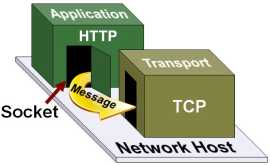
Image Credit : Microchip
Internally, sockets implement receive (RX) and transmit (TX) buffers. When a process wants to transmit a packet, it writes the packet to the socket’s TX buffer. Similarly, data is read from the RX buffer.
Socket Operations
Application needs to manage the life cycle of a socket. For TCP, the following step applies
- server creates a socket, checks for incoming messages
- client creates a socket connecting to the server, server assigns new socket for this connection
- data transmission using buffers
- sockets on both server and clients are closed
Sockets have states, these states allow processes to perform the right system calls to transit from one state to the next.
1 - Server socket creation
A server needs to create socket to receive incoming connections from client with the following steps
- creating the socket, with
sockfd = socket(), getting the file descriptor of the socket. The state of the socket now isCLOSED - set the option of the socket, with
setsockopt - bind the socket to the address and port number in
bind(sockfd, addr, addr_len) - puts the socket into the passive mode with
listen(sockfd, backlog)with a backlog queue (BSD ref), the socket transits toLISTENstate. - listens and creates new socket with
new_socket = accept(sockfd, addr, addr_len)later on
After listen(), this socket is a passive socket, which may not initiate connections. It also has a queue to hold pending incoming connections.
2 - Client socket creation & establishing TCP connection
A client should be aware of the destination address and port. Before sending data to the server, it needs to create a socket with the destination address, with
- creating a new socket, same as server, with
sockfd = socket(), the state of the client socket now isCLOSED - connect socket to server with
connect(sockfd, server_addr, server_addr_len), this attempts to establish a TCP connection.
When connect() is called, the kernel performs TCP three way handshake, sockets on both server and client begin transiting through different states.
SYN: At this stage, the client socket transitions from CLOSED to the SYNC_SENT stage, and after the server receives the SYN successfully, it allocates a new socket, and transitions the new socket to the SYN_RCVD state.
SYN-ACK: Next, the server writes the SYN-ACK packet to the socket, the client waits for this packet and upon receiving, transitions to the ESTABLISHED state and respond to the server with the final ACK.
ACK: Lastly, upon receiving the ACK, the server also transitions to the ESTABLISHED state. Both the server and client sockets are fully established.
3 - Data transmission via socket buffers
After both sockets are created, client can attempt delivery. The process will write data to the TX buffer of its socket, with write(fd, buffer, buffer_size), and read using read().
4 - Terminating connection
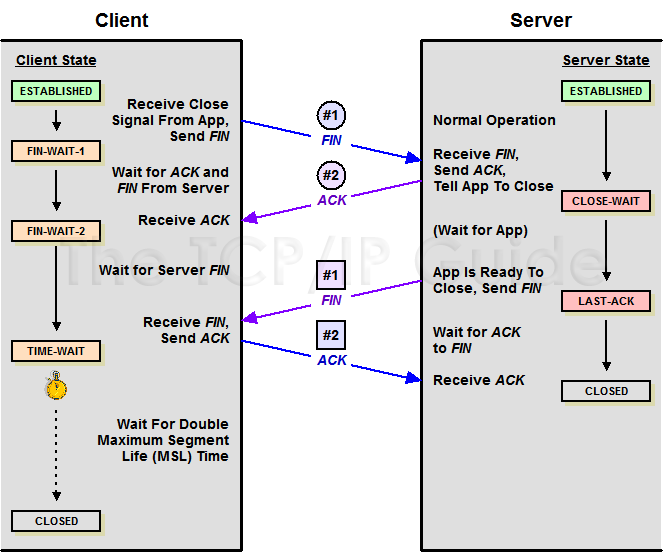
Only client process can establish a connection with the first SYN packet, but either client or server can initialise connection termination with the first FIN packet.
Since there could be data remaining in the buffers when one side sends the FIN request, it may take sometime to complete the delivery and send its own FIN. Therefore, termination handshake does not group FIN and ACK into one like SYN-ACK.
After sometime, the other process can send its own FIN to finally indicate it’s not sending more data. Connection is terminated, and the file descriptor, port and resources are released back to the OS.
Berkeley / BSD
The Berkeley sockets are a set of APIs defined for network communication, this set of APIs have become the de facto standard for socket based networking.
Some key functions include socket() - creating a socket and returns bind() - associate a socket with a local port listen() - marking the socket as passive, allows it to accept for incoming connections connect() - used by client to initiate a connection send() / write() and read() / recv() - socket IO close() - closes a socket and release resources. select() / poll() - monitors multiple sockets to see if they are ready for reading