Uncrossed Lines (Link)
Topics: tree, DFS, DP
Description
Given two integer arrays, find the maximum number of non-intersecting lines between these arrays. We can connect two same elements with a line. For example, the following will have 3 lines. We cannot connect 4-4 because it will block 2-2 connections.
1 2 2 4
|  \ \
1 4 2 2
Optimal Substructure
Given two arrays \(l_1, l_2\), which have lengths \(m,n\). The optimal solution for the max connection can be defined as \(dp(S_1(l_11,l_12...l_1m), S_2(l_21,l_22...l_2n)) = dp(l_1,l_2)\), where we consider the entire \(l_1\) and \(l_2\).
We observe that if \(l_{11} = l_{21}\), then the optimal solution can be represented as
\[1 + dp(S_1(l_12...l_1m), S_2(l_22...l_2n))\]If \(l_{11} \neq l_{21}\), then we can choose \(l_{12}\), or \(l_{22}\) as the next element, the optimal solution can then be represented as
\[\begin{aligned} dp(l_1, l_2) & = max(\\ & dp(S_1(l_{11}...l_{1m}), S_2(l_{22}...l_{2n})), \\ & dp(S_1(l_{12}...l_{1m}), S_2(l_{21}...l_{2n})), \\ & ) \end{aligned}\]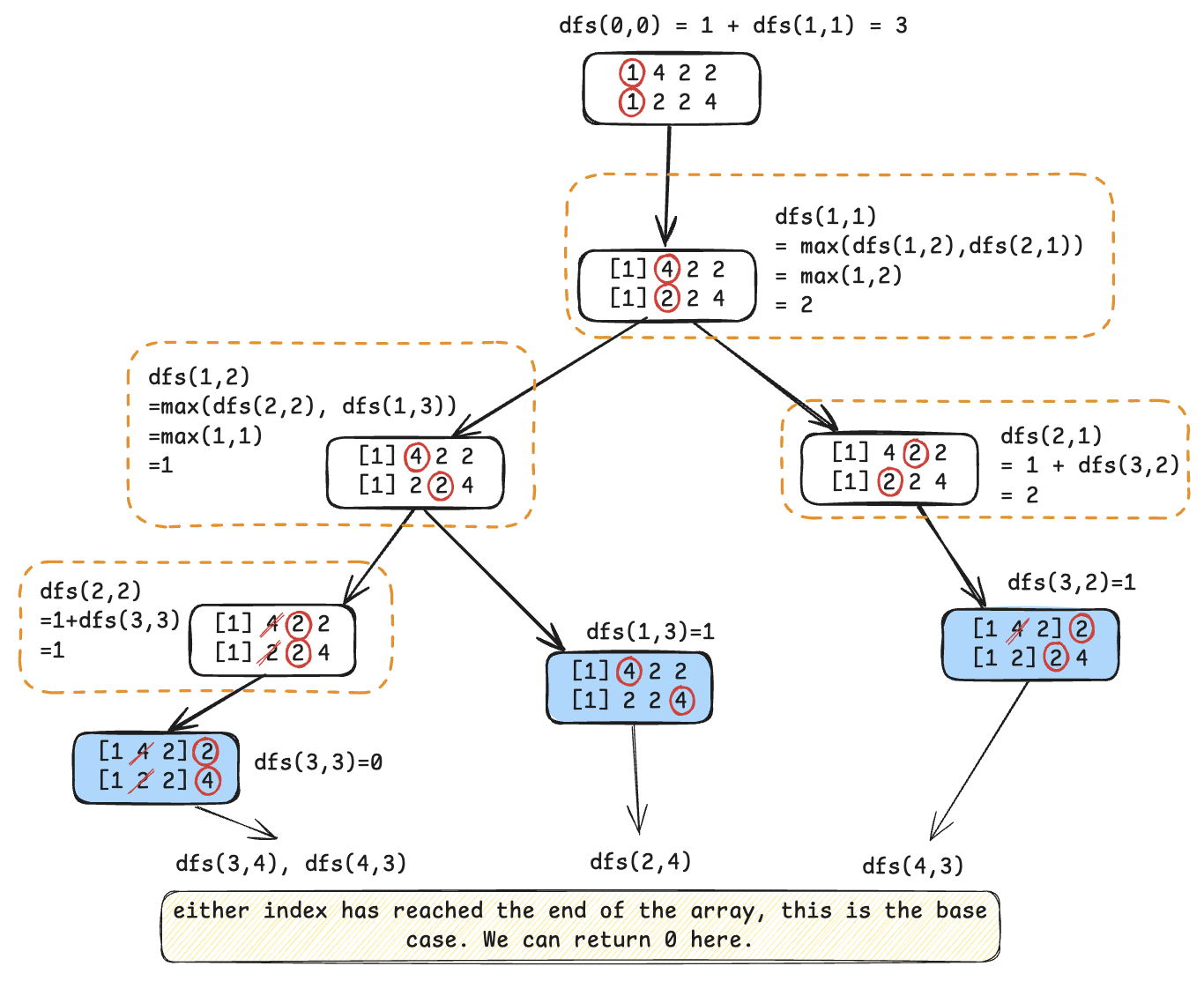
The same recurrence relation can also be represented with a 2D integer array.
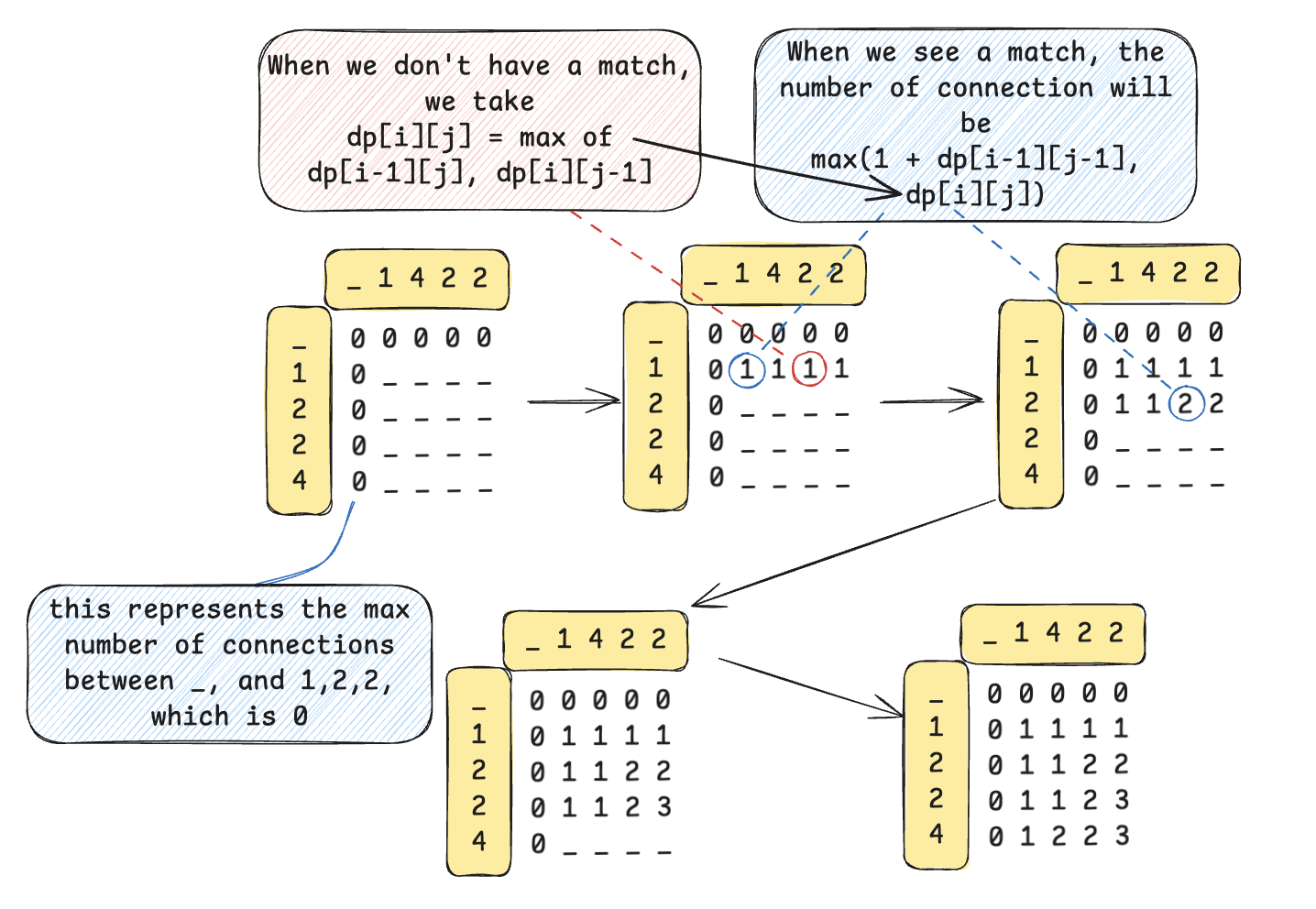
Overlapping Subproblem
We may visit the same i,j multiple times, when we do encounter the same i,j, we can refer to the cached value in dp and return early.
Solution
DFS with a cache:
func memo(nums1, nums2 []int) int {
	dp := map[[2]int]int{}
	var dfs func(i, j int) int
	dfs = func(i, j int) int {
		if i >= len(nums1) || j >= len(nums2) {
			return 0
		}
		if val, exists := dp[[2]int{i, j}]; exists {
			return val
		}
		if nums1[i] == nums2[j] {
			dp[[2]int{i, j}] = 1 + dfs(i+1, j+1)
		} else {
			dp[[2]int{i, j}] = max(dfs(i+1, j), dfs(i, j+1))
		}
		return dp[[2]int{i, j}]
	}
	dfs(0, 0)
	return dp[[2]int{0, 0}]
}
Iterative with a 2D table:
func dp(nums1, nums2 []int) int {
	dp := make([][]int, len(nums1)+1)
	for i := range dp {
		dp[i] = make([]int, len(nums2)+1)
	}
	for i := 0; i < len(nums1); i++ {
		for j := 0; j < len(nums2); j++ {
			dp[i+1][j+1] = max(dp[i][j+1], dp[i+1][j])
			if nums1[i] == nums2[j] {
				dp[i+1][j+1] = max(dp[i+1][j+1], 1+dp[i][j])
			}
		}
	}
	return dp[len(nums1)][len(nums2)]
}