Data Serialization
Also called pickling, marshalling, serialization is the process of translating a data structure’s representation into a format that can be stored or transmitted.
For example, a tree can be represented as a nested structure with a Node structure with pointers to its left and right children.
A tree represented this way can be serialized into an integer array. An integer array is more convenient to be stored and transmitted. For example, we can use the following formulas to assign a node to a position in an array
root_index = 1
left_child_index = 2 * parent_index
right_child_index = 2 * parent_idnex + 1
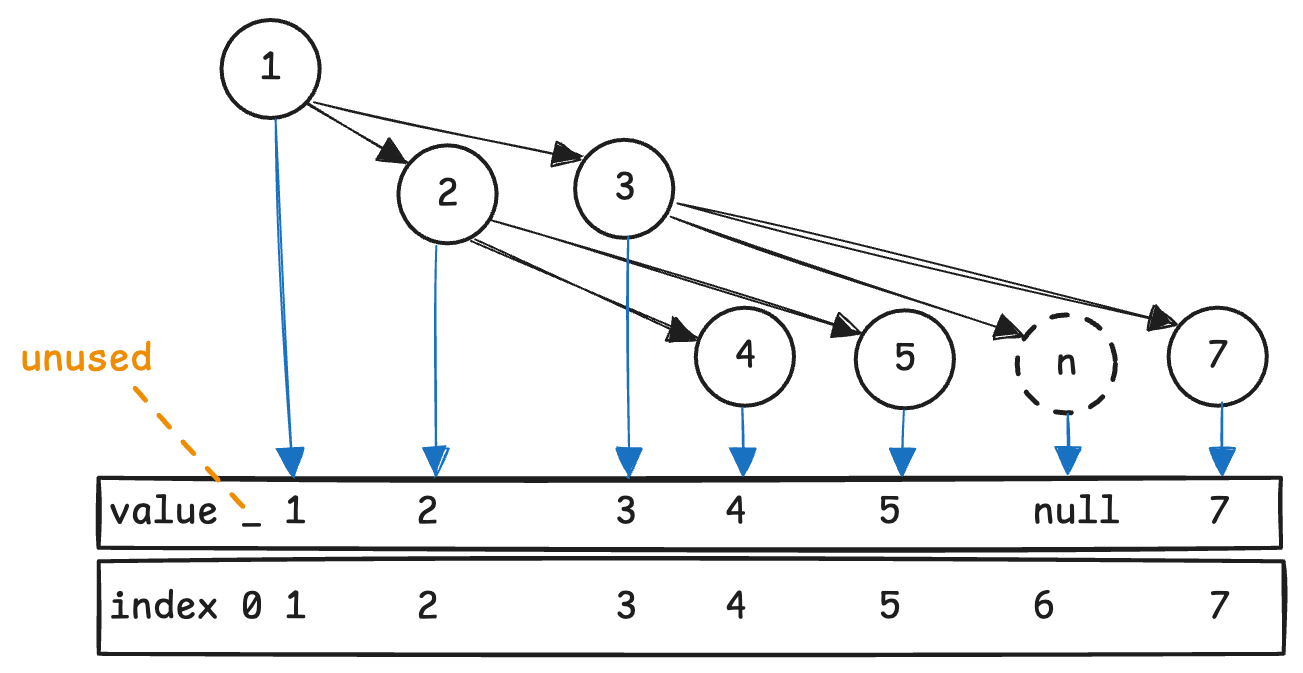
We can also serialise a tree with pre-order, in-order, and post-order walks.
Problem 1 - Serializing and Deserializing a binary tree (Link)
Serialising
I find the above serialization method is simple to understand, and deserialise from, however, it will incur a huge memory cost tracking null nodes if the tree is really skewed.
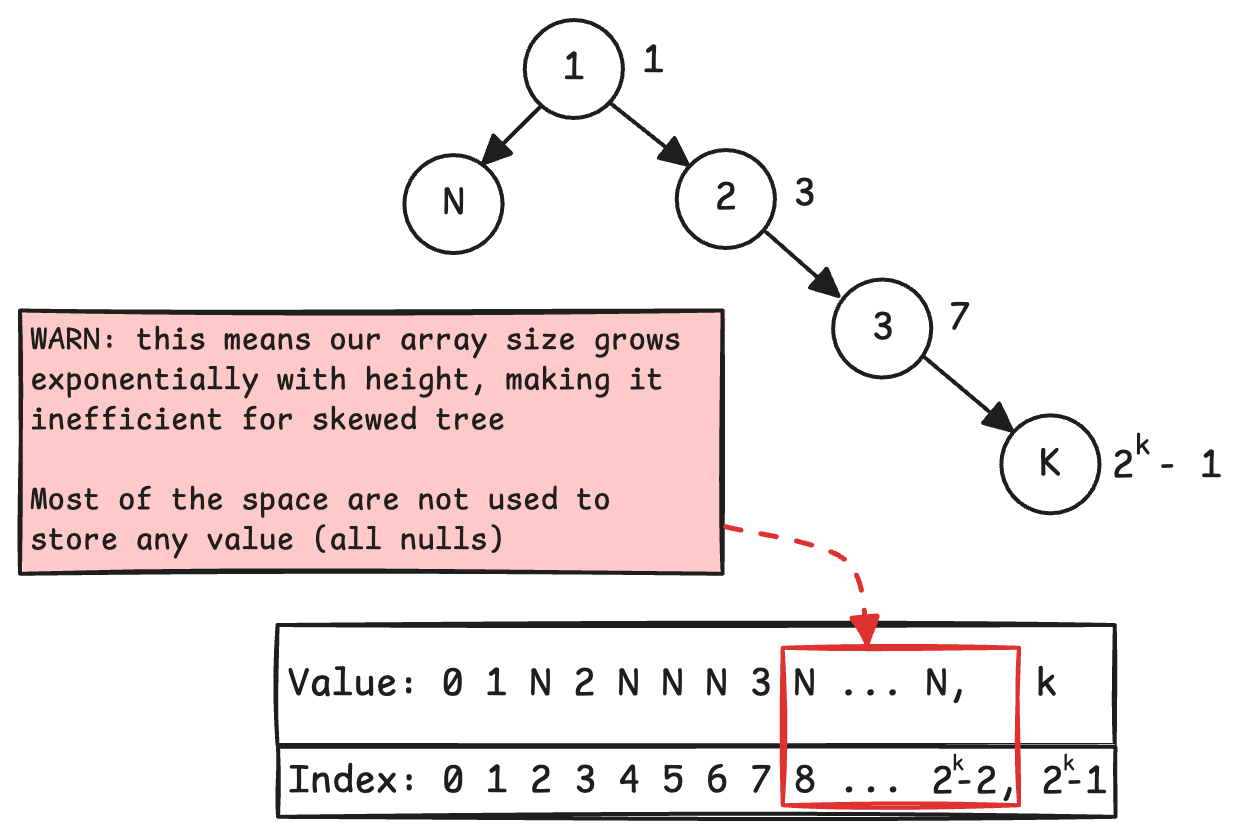
If we have a right skewed tree with 10 nodes, then we will need an array of size \(2^{10}-1=1023\) to track the tree.
Hence, we need to find a more memory efficient way to track the tree. We have to maintain markers to represent the null children.
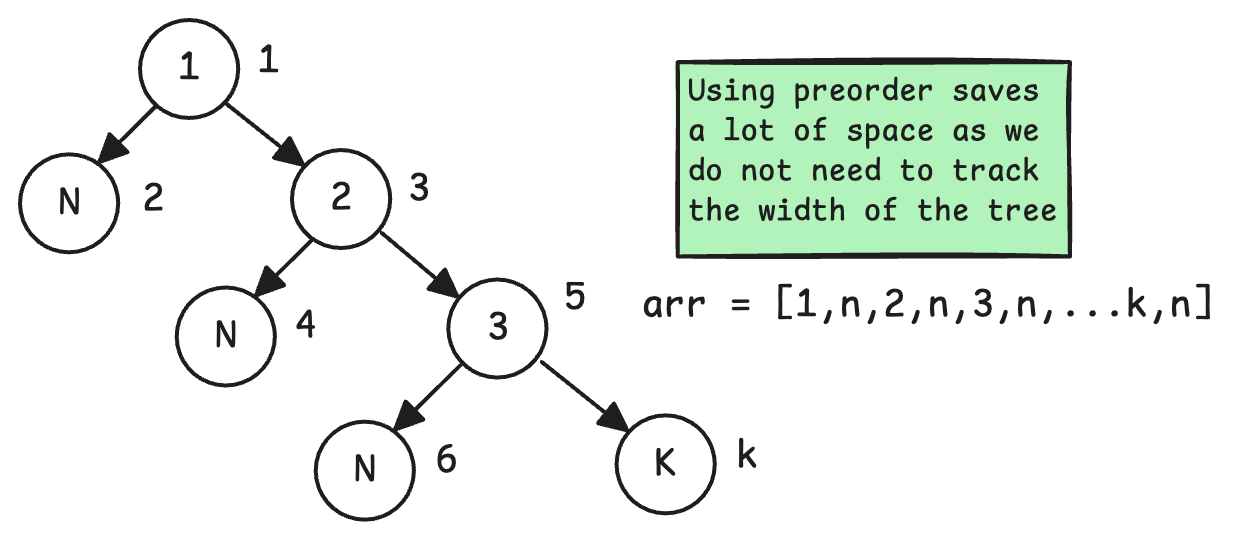
An alternative is to store the preorder walk of the tree, where we append the node first (hence pre-), then the left and right child.
func serialize(root *TreeNode) string {
	var preOrder func(node *TreeNode)

	buf := []byte{}
	preOrder = func(node *TreeNode) {
		if node == nil {
			buf = append(buf, 'n')
			buf = append(buf, ',')
			return
		}

		numStr := strconv.Itoa(node.Val)
		buf = append(buf, []byte(numStr)...)
		buf = append(buf, ',')

		preOrder(node.Left)
		preOrder(node.Right)
	}
	preOrder(root)
	return string(buf[:len(buf)-1])
}
We can see the improvement in space usage, for a skewed tree, we need much less space to represent the tree.
Deserialising
After a tree is serialised, we also need a function to reconstruct the tree into the original representation with TreeNodes.
Pre-order walk will visit the root of a subtree first. Therefore, the first element of a pre-order array will be the root of the current subtree, and the remaining elements of the array will form its left and right children.
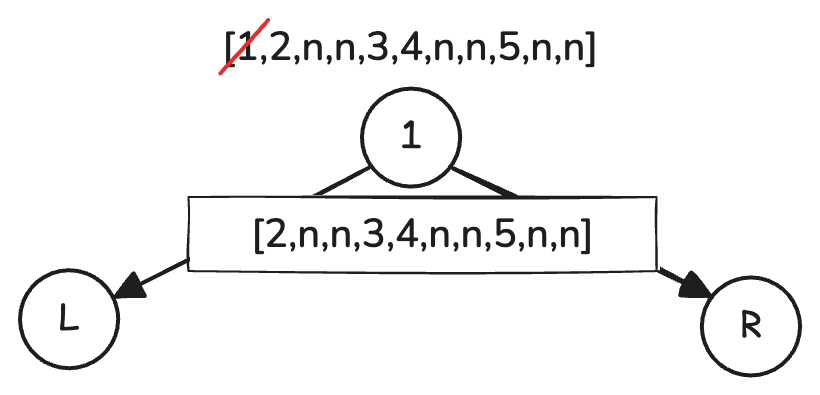
In the above example, we can determine the root will be 1.
After visiting the root, pre-order walk will visit the left child. Hence, we know that the first element of the remaining array must be the root of the left subtree, which is 2 in this case.
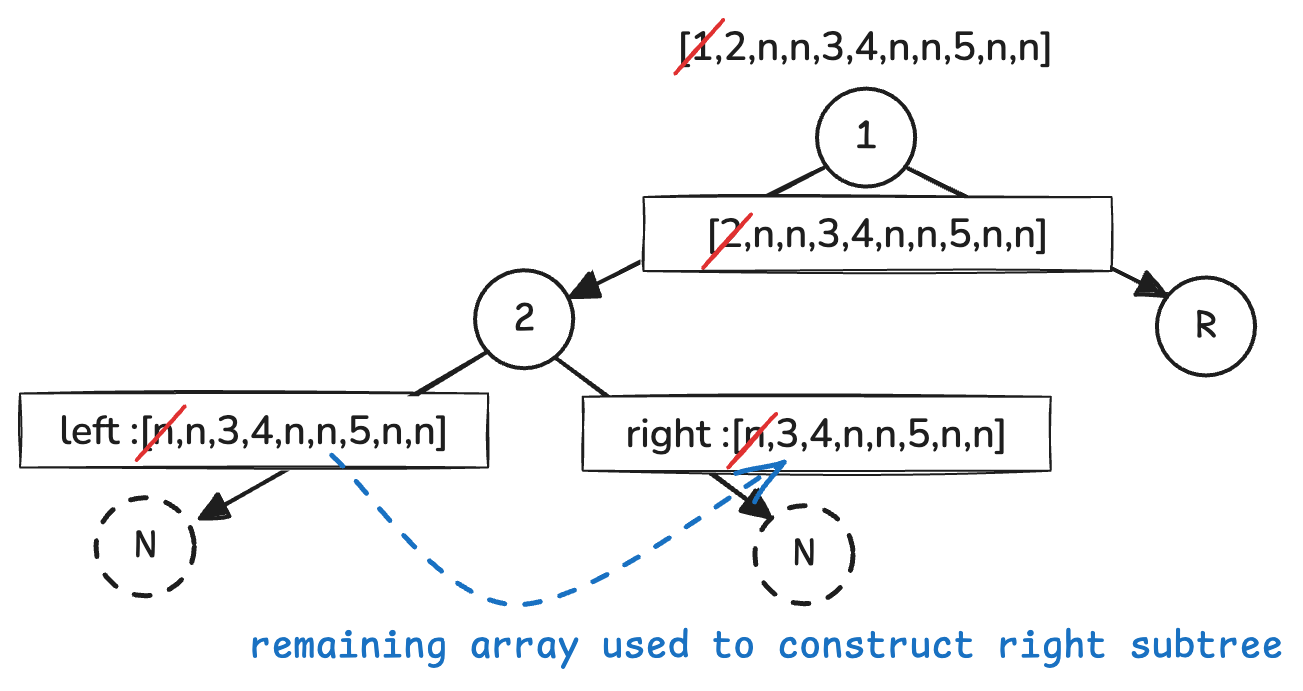
With reference to the diagram above, we then enter a recursive case where 2 is the root of the subtree. The next element in the array happens to be n - this suggests that the left subtree is null, and the elements after this forms the right subtree.
The right subtree also happens to be null, now we know that the 2 subtree is completed. We can return whatever that’s remaning (3,4,n,n,5,n,n) to 2’s parent 1, as it will form 1’s right subtree.
With this understanding, we can use our Preorder DFS function to deserialise the tree.
// construct a tree given vals, return the root and remaining unused vals
var Preorder func(vals []string) (*Node, []string)

Preorder = func(vals []string) (*Node, []string) {
    if len(tokens) == 0 {
        return nil, []string{}
    }

    if tokens[0] == "n" {
        return nil, tokens[1:]
    }

    num, _ := strconv.Atoi(tokens[0])
    currRoot := Node{
        Val: num,
    }

    leftSubTreeTokens := tokens[1:]

    leftSubTree, rightSubTreeTokens := preOrder(leftSubTreeTokens)
    rightSubTree, parentRightSubTreeTokens := preOrder(rightSubTreeTokens)

    currRoot.Left = leftSubTree
    currRoot.Right = rightSubTree

    return &currRoot, parentRightSubTreeTokens
}
To deserialise, we just need to do some tokenisation on the input string from earlier
func (this *Codec) deserialize(data string) *TreeNode {
	tokens := strings.Split(data, ",")
	root, _ := preOrder(tokens)
	return root
}
The complexity will just be \(O(N)\) where N is the number of nodes, since we only visit each node once with DFS.
Problem 2 - Same thing, but on a BST (Link)
WIP